Free Foot Reflexology Charts: How to Find, Read, and Use Them
A foot reflexology chart can make a foot massage feel more intentional: it maps areas of the feet to parts of the body and offers a guide to where you might focus your hands. Free charts are easy to find online, but they vary in clarity and quality—and it’s important to understand what they can and cannot tell you.
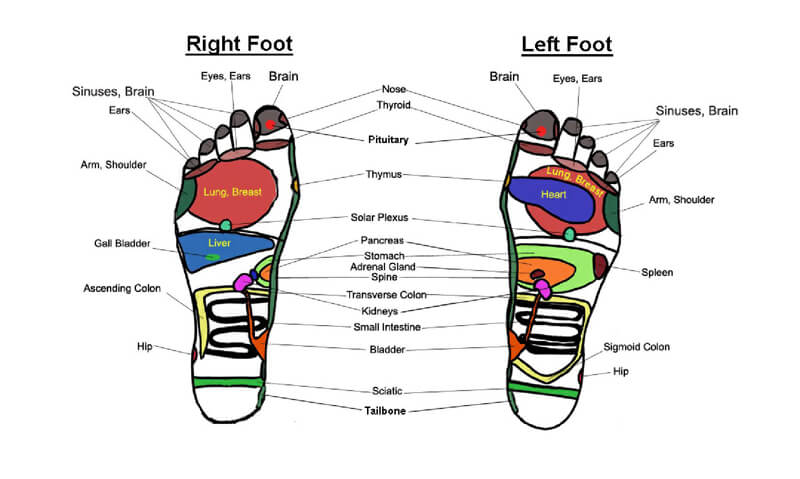 This guide explains how to find and read a free foot reflexology chart, how to use one safely for relaxation, and what the evidence says about reflexology.
What Is a Foot Reflexology Chart?
Reflexology is a complementary practice in which pressure is applied to specific areas of the feet, hands, or ears. A foot reflexology chart typically labels zones on the soles, tops, and sides of the feet with body parts or systems—for example, the toes may be associated with the head, while areas farther down the foot may be associated with the torso.
These maps represent the traditional framework used by reflexologists. They are not anatomical diagrams, and the mapped zones should not be interpreted as proven pathways to internal organs or as a way to diagnose illness.
Where to Find Free Foot Reflexology Charts
Free charts are widely available from wellness websites, massage-therapy organizations, educational pages, and printable-resource libraries. To find a useful one, try searching for:
- “free printable foot reflexology chart”
- “foot reflexology map labeled”
- “reflexology chart top and sole of foot”
- “foot reflexology chart with instructions”
Choose a chart that:
- Shows both feet and, ideally, the sole, top, and sides.
- Uses readable labels and a clear legend.
- Identifies the source, author, or organization behind it.
- Distinguishes a traditional reflexology map from medical or anatomical information.
- Can be downloaded or printed without requiring you to provide sensitive personal information.
If a chart makes dramatic promises—such as claiming it can cure a disease or identify a medical problem by touching a particular spot—treat it with caution.
How to Read a Reflexology Chart
Charts differ in their layouts and labels, so begin by checking the legend and any accompanying instructions. Many charts divide each foot into zones and assign those zones to body regions. Some also show a sequence of pressure points or recommend particular techniques.
Keep in mind that there is no single universally accepted chart. Two charts may place or label a zone differently. Use the chart as a reference for a relaxation practice, not as a precise diagnostic map.
A Gentle Way to Use a Chart at Home
You don’t need specialized equipment to try a brief foot massage. A simple approach is:
- Get comfortable. Sit somewhere stable, and support your foot so you can reach it without straining.
- Check your feet. Don’t massage areas with open wounds, infection, significant swelling, or unexplained pain.
- Warm the foot. Gently rub the sole and top of the foot for a minute or two.
- Use light, comfortable pressure. Press or make small circles with a thumb or fingertip. Move gradually around the foot rather than forcing pressure into one spot.
- Adjust to your comfort. Pressure should not cause sharp pain, numbness, or lingering soreness.
- Repeat on the other foot if you like. There is no need to follow a chart perfectly or to spend a long time on one area.
Some people use reflexology as part of a calming routine. If it feels soothing, that may be enough reason to include it in a self-care practice—without assuming that a particular spot is treating a particular organ.
What Does the Evidence Say?
Reflexology is often promoted for a range of health concerns, but the evidence is limited and varies by condition. The U.S. National Center for Complementary and Integrative Health describes reflexology as a practice based on the idea that pressure points correspond to other parts of the body, while noting that scientific evidence for many claimed health benefits is limited.[1]
Some research reviews have examined reflexology for symptoms such as pain, anxiety, or nausea. Results are mixed, and studies may differ in size, design, and quality. A review published in Maturitas, for example, found that evidence for reflexology’s effectiveness across several conditions was not strong enough to support many broad health claims.[2] More research is needed to determine whether any benefits go beyond relaxation, attention, or the effects of touch.
That does not mean a gentle foot massage cannot feel pleasant. It does mean a chart should not be used to decide what condition someone has or what treatment they need.
Safety and When to Seek Medical Advice
For many people, a gentle foot massage is low risk. Still, use extra care if you have reduced sensation, circulation problems, a clotting disorder, a history of blood clots, or a foot injury. Ask a healthcare professional before trying reflexology if you have a medical condition that could make pressure or massage unsafe.
Stop if you experience pain, tingling, bruising, or worsening symptoms. And don’t use reflexology instead of medical care. New or persistent symptoms—such as unexplained swelling, numbness, severe pain, or changes in skin color—deserve assessment by a qualified healthcare professional.
Tips for Choosing a Printable Chart
Before printing a free chart, take a moment to evaluate it:
- Check who published it. A named health or educational organization is more transparent than an unattributed graphic.
- Look for context. Good resources explain that reflexology charts reflect a complementary practice, not established anatomy.
- Compare labels carefully. Differences between charts are a reminder that the maps are not standardized.
- Avoid treatment promises. A chart that claims to cure illnesses or replace medical care is not a reliable health resource.
- Review usage rights. “Free to view” does not always mean “free to reproduce.” Check the site’s terms before sharing or republishing a chart.
Conclusion
A free foot reflexology chart can be a handy visual guide for a relaxing foot massage. Look for a clear, responsibly sourced chart, use gentle pressure, and let comfort—not the map—guide your practice. Reflexology may be enjoyable as a complementary form of self-care, but current evidence does not establish that charted foot zones diagnose or treat diseases. For medical concerns, use a chart as no substitute for qualified healthcare advice.
Sources
- National Center for Complementary and Integrative Health (NCCIH), “Reflexology”.
- Ernst, E. “Is reflexology an effective intervention? A systematic review of randomised controlled trials.” Maturitas 42, no. 3 (2002): 211–215. https://doi.org/10.1016/S0378-5122(02)00051-0.