Doctor Excuse Note Templates: What to Include, How to Use Them, and Important Limits
A sudden illness or medical appointment can disrupt work, school, or other commitments. When that happens, an employer or school may ask for documentation explaining an absence. A doctor excuse note template can help organize the relevant information—but it should be completed or confirmed by a healthcare professional, and it should never be used to invent a diagnosis, appointment, or medical restriction.
This guide explains what a legitimate note usually contains, offers practical templates for healthcare offices, and covers privacy, workplace rules, and common mistakes.
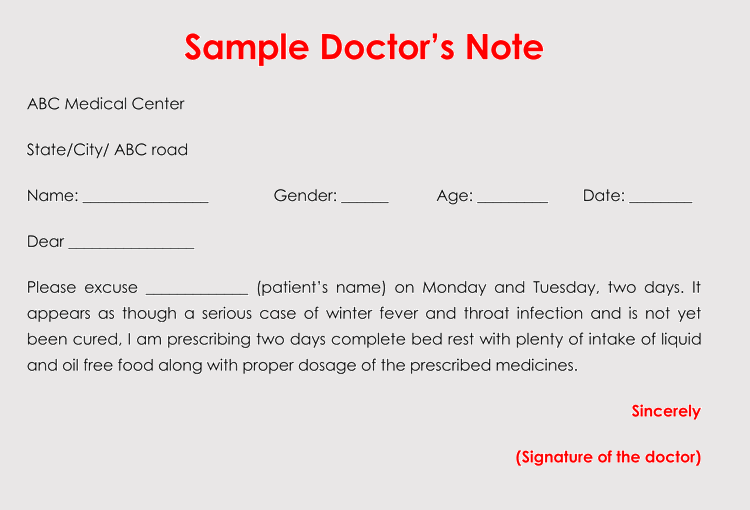 What Is a Doctor Excuse Note?
A doctor excuse note—also called a medical excuse, visit verification, or healthcare provider note—is documentation from a medical professional confirming a visit or describing a work or school limitation. Depending on the situation, it may:
- Confirm that a person attended an appointment on a particular date
- Recommend time away from work or school
- State when the person may return
- Identify temporary restrictions, such as avoiding strenuous activity
- Confirm that a caregiver accompanied a patient, when appropriate
The note’s purpose is generally to document attendance or functional limitations—not to provide a full medical history.
Who Should Write or Complete the Note?
A healthcare provider or authorized staff member should issue or verify a medical note. Patients can use a template to request the information they need, but should not present a self-written document as though a clinician created or signed it.
Rules and practices vary by healthcare office, employer, school, and location. Some clinics provide a standard letter; others use a visit summary or a dedicated form. If an organization has its own paperwork, ask whether that form is required.
What to Include in a Doctor Excuse Note
A clear note usually includes only the information needed to explain the absence or restriction:
-
Provider or practice identification
The clinic’s name and contact details, preferably on official letterhead. -
Patient identification
The patient’s name. Include a date of birth or other identifier only if the receiving organization needs it. -
Relevant date or dates
The date of the appointment and, if recommended by the provider, the dates covered by the absence. -
A limited confirmation or recommendation
For example, that the patient was seen, or that the provider recommends time away from work or school. A diagnosis is not automatically necessary. -
Return date or restrictions, if applicable
These should reflect the provider’s actual assessment. If restrictions are needed, describe what the person can or cannot do and for how long. -
Provider authentication
The provider’s name, credentials, signature or approved electronic authentication, and the date the note was issued.
A note should be accurate, readable, and limited to the purpose for which it was requested.
Doctor Excuse Note Templates
The following are drafts for a healthcare office to review and complete. They are not proof of a medical visit unless issued or authenticated by the provider.
1. Appointment Verification
[Clinic or Practice Letterhead]
Date issued: [Date]To whom it may concern:
This letter confirms that [patient’s name] attended an appointment with [practice/provider name] on [appointment date].
[Optional, if appropriate: The appointment took place from approximately [start time] to [end time].]
Sincerely,
[Provider or authorized staff member’s name and title]
[Signature or approved electronic authentication]
[Practice contact information]
This version confirms attendance without stating a diagnosis.
2. Short Absence Recommendation
[Clinic or Practice Letterhead]
Date issued: [Date]To whom it may concern:
[Patient’s name] was evaluated by [provider or practice] on [date]. Based on the evaluation, the provider recommends that the patient be excused from [work/school] on [date or dates].
The patient may [return on date / follow the restrictions below / contact the provider for reassessment].
Sincerely,
[Provider’s name and credentials]
[Signature or approved electronic authentication]
[Practice contact information]
The provider should choose the dates and return guidance based on the individual’s circumstances.
3. Return-to-Work or Return-to-School Note
[Clinic or Practice Letterhead]
Date issued: [Date]To whom it may concern:
[Patient’s name] may return to [work/school] on [return date].
[If applicable: The following temporary restrictions are recommended through [date]: [specific, relevant restrictions].]
Sincerely,
[Provider’s name and credentials]
[Signature or approved electronic authentication]
[Practice contact information]
If no restrictions are needed, omit that section rather than adding unnecessary medical detail.
4. Caregiver or Dependent Appointment Verification
[Clinic or Practice Letterhead]
Date issued: [Date]To whom it may concern:
This confirms that [caregiver’s name] accompanied [patient’s name or appropriate identifier] to an appointment at [practice name] on [date].
[If appropriate: The caregiver’s presence was requested or reasonably needed for the appointment.]
Sincerely,
[Provider or authorized staff member’s name and title]
[Signature or approved electronic authentication]
[Practice contact information]
Whether a school or employer accepts caregiver documentation depends on its policies and applicable law.
Privacy: Does the Note Need to Name the Diagnosis?
Often, a note can confirm an appointment or describe a work limitation without naming the underlying condition. Share only what is necessary for the request, and ask the recipient what documentation it requires before disclosing sensitive details.
In the United States, the Health Insurance Portability and Accountability Act (HIPAA) generally regulates how covered healthcare providers and health plans use and disclose protected health information. It does not generally give an employer the right to obtain a worker’s medical records directly from a provider without authorization. Employment-related rules can still require certain documentation, and other privacy laws may apply depending on the circumstances.[1]
For workplace accommodations under the Americans with Disabilities Act (ADA), an employer may request limited documentation when a disability or need for accommodation is not obvious. The Equal Employment Opportunity Commission (EEOC) advises that such requests should be limited to information needed to establish the disability and explain the need for accommodation; employers should keep medical information confidential, subject to applicable exceptions.[2]
Medical Notes and Leave Laws
A brief excuse note is not the same thing as a formal leave request, accommodation approval, or certification required by a law or workplace policy.
For example, eligible employees may request leave under the U.S. Family and Medical Leave Act (FMLA), but the process may involve specific notice requirements and a certification from a healthcare provider. The U.S. Department of Labor provides information and forms for FMLA certification.[3] A generic template may not satisfy those requirements.
People seeking workplace accommodations may also need to follow their employer’s process and discuss reasonable adjustments. The applicable rules depend on the person’s situation, the employer, and the jurisdiction. If the stakes are significant, consult the relevant government agency, a qualified employment professional, or an attorney.
How to Request a Note
To avoid delays, contact the healthcare office as soon as possible and ask:
- Whether the office can confirm the visit or provide a work/school note
- What information the note can include
- Whether the recipient has supplied a form that the provider must complete
- How the note will be delivered and whether there is a fee
- Whether the office can document a past visit
Explain the recipient’s requirements, but do not ask the provider to certify dates or restrictions that are not medically supported. If the organization only needs proof of attendance, say so; a simpler note may protect your privacy.
Common Mistakes to Avoid
- Creating or altering a note and presenting it as provider-issued. This may be treated as falsification and can lead to disciplinary or other consequences.
- Including an unsupported diagnosis or medical restriction. The provider should decide what information is medically appropriate.
- Assuming every absence requires a diagnosis. Ask the employer or school what documentation it actually needs.
- Using a generic note for a formal leave or accommodation process. Official forms or additional steps may be required.
- Sending sensitive details to the wrong recipient. Confirm where and how documentation should be submitted.
- Assuming a note guarantees approval. A note may document a visit, but the recipient’s policies and applicable laws determine how an absence or request is handled.
Conclusion
Doctor excuse note templates can make it easier for healthcare offices to document appointments, recommended absences, and temporary restrictions. The safest approach is to use a template only as a starting point, have the provider review and authenticate it, and disclose no more medical information than the situation requires. For formal leave or accommodation requests, check the relevant policy and use the required process rather than relying on a generic note.
Sources
- U.S. Department of Health and Human Services, “Employers and Health Information in the Workplace”: https://www.hhs.gov/hipaa/for-individuals/employers-health-information-workplace/index.html
- U.S. Equal Employment Opportunity Commission, “Enforcement Guidance on Disability-Related Inquiries and Medical Examinations of Employees Under the ADA”: https://www.eeoc.gov/laws/guidance/enforcement-guidance-disability-related-inquiries-and-medical-examinations-employees
- U.S. Department of Labor, Family and Medical Leave Act forms and resources: https://www.dol.gov/agencies/whd/fmla/forms
- U.S. Department of Labor, “Fact Sheet #28: The Family and Medical Leave Act”: https://www.dol.gov/agencies/whd/fact-sheets/28-fmla
Related For Doctor Excuse Note Templates: What to Include, How to Use Them, and Important Limits

Fake Doctor’s Notes: The Risks, C
A missed shift, an upcoming exam, or a sudden