Free Conference Plan Template: Master Event Logistics & Budget
Planning a professional conference—whether it is a 200-person regional corporate seminar in Chicago or a multi-day international tech summit in Amsterdam—is a massive operational undertaking. According to industry benchmarks, a successful corporate event requires tracking over a hundred moving parts, including venue sourcing, AV calibration, speaker itineraries, and multi-tier ticketing marketing pipelines.
Without a centralized, rigid planning framework, tracking deadlines becomes chaotic, leading to budget overruns and missed logistical steps.
To help you streamline your event management pipeline, we have engineered an all-in-one Conference Plan Template framework compatible with Microsoft Excel, Google Sheets, and Apple Numbers. Below is the operational blueprint to organize your next high-impact conference from initial conception to post-event breakdown.
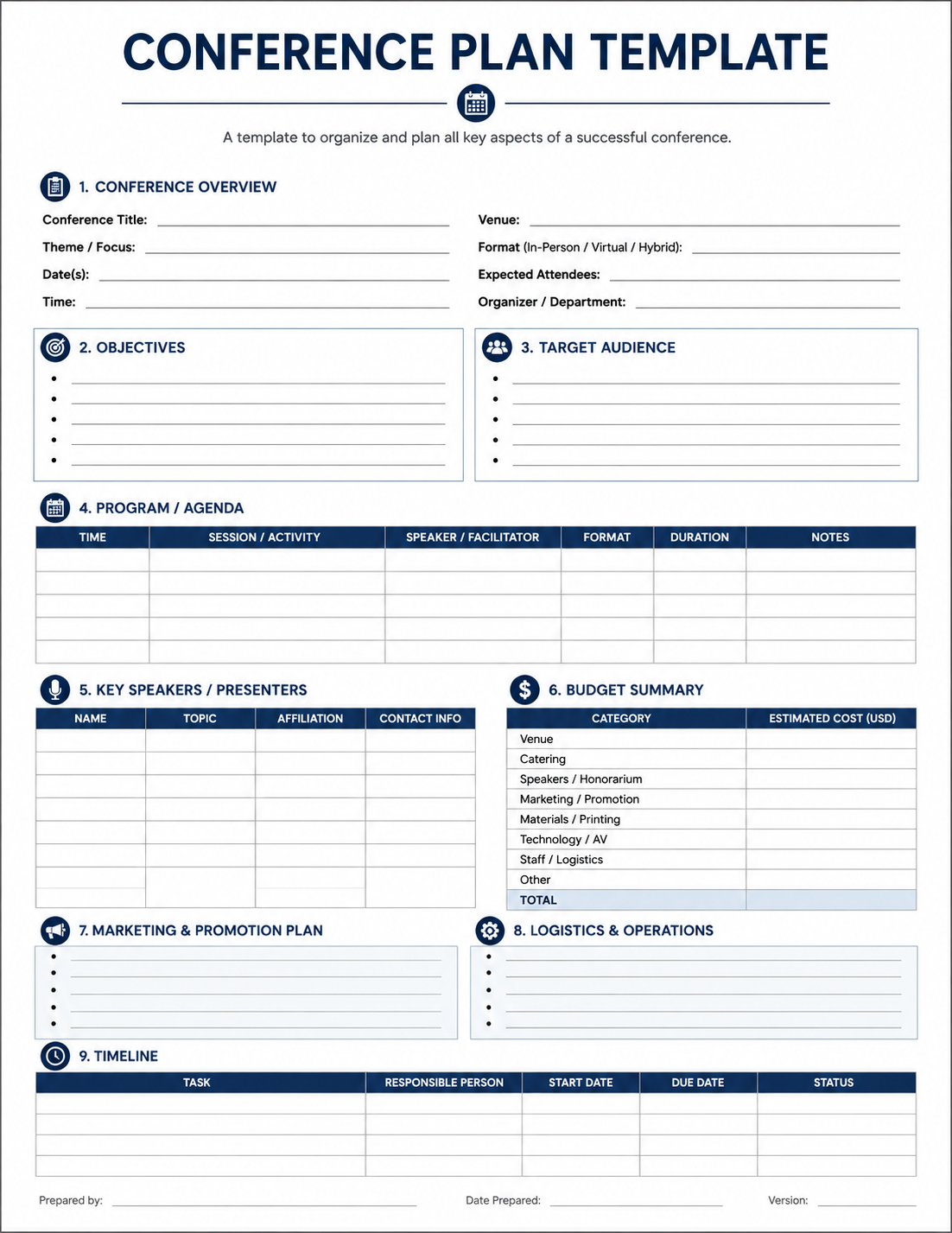
Free Conference Plan Template Master Event Logistics & Budget
The Master Conference Planning Timeline (12-Month Blueprint)
An effective conference plan template divides operations into strategic chronological phases. For major events in the US and European markets, a 12-month countdown ensures stable vendor pricing and optimal speaker availability.
1. Phase 1: Conceptualization & Budgeting (Months 12 – 9)
-
Establish Key Objectives: Define the core theme, target audience personas, and value proposition.
-
Draft the Budget Workspace: Estimate fixed costs (venue hire, insurance) vs. variable costs (catering per head, attendee swag bags).
-
Secure the Venue: Finalize the geographic location and lock in dates, verifying there are no major competing industry conventions in the local city index.
2. Phase 2: Speaker Curation & Logistics (Months 8 – 5)
-
Call for Papers (CFP): Launch your abstract submission portal for breakout track sessions.
-
Keynote Procurement: Secure contracts for high-profile industry keynote speakers, detailing travel stipends, hotel blocks, and honorariums.
-
A/V & Tech Sourcing: Secure vendors for live-streaming, recording feeds, and stage lighting matrices.
3. Phase 3: Marketing & Registration Push (Months 4 – 1)
-
Early Bird Ticket Sales: Roll out discounted registration tiers to build initial operational capital.
-
Sponsorship Activation: Send out structured sponsorship decks to corporate partners offering tiered booth space and branding real estate.
-
Catering Finalization: Lock in the final headcount matrix with your venue food service provider, noting dietary restriction allocations (vegan, gluten-free).
Essential Tracking Modules to Include in Your Template
A flat checklist is not enough to manage a modern event. Your interactive spreadsheet layout should contain these dedicated sub-tabs:
Module A: Budget & Expense Variance Tracker
This module calculates your projected vs. actual expenditures in real-time, helping you protect your ROI margins.
| Expense Category | Projected Cost (USD) | Actual Cost (USD) | Variance Balance | Status |
| Venue Deposit | $5,000.00 | $5,000.00 | $0.00 | Fully Paid |
| A/V Production | $7,500.00 | $8,200.00 | +$700.00 | Over Budget |
| Keynote Honorarium | $3,500.00 | $3,500.00 | $0.00 | Pending Escrow |
| Catering Deposit | $4,000.00 | $3,850.00 | -$150.00 | Under Budget |
Module B: Speaker & Session Itinerary Sheet
Keep track of your thought leaders’ logistics to ensure the stage schedule never experiences a lapse:
-
Fields: Speaker Name | Presentation Title | Assigned Room/Stage | Arrival Time | AV Requirements (Lapel Mic, HDMI connection, Clicker) | Presentation Slides Upload Status (
Pending / Approved).
3 Critical Failure Points in Conference Planning (And How to Fix Them)
-
Underestimating AV Technical Rehearsals: Never assume equipment works out of the box. Always allocate a strict 4-to-6-hour “Tech Run-Through” window the day before the doors open to test wireless frequencies, projector resolutions, and virtual streaming feeds.
-
Ignoring Local Compliance and Insurance: In both the USA and EU, hosting a public or corporate gathering requires a comprehensive General Liability Insurance policy. Your plan must account for local fire marshal capacity limits, emergency exit clearances, and ADA (Americans with Disabilities Act) accessibility guidelines.
-
Vague Vendor SLA Agreements: Ensure every vendor contract clearly states arrival times, setup durations, overtime billing hours, and cancellation refund percentages directly within your Master Vendor Index sheet.
Conclusion
Successfully executing a professional corporate convention comes down to flawless database and timeline tracking. By implementing a multi-module conference plan template, your core organizing committee can coordinate tasks smoothly, protect budget resources, and deliver a world-class attendee experience.
Related For Free Conference Plan Template: Master Event Logistics & Budget

21+ Sample T Shirt Order Form Templ
21+ Sample T Shirt Order Form Template. T shirt
5+ Sample Ballot Template
5+ Sample Ballot Template. Enter your email if you
15+ Resignation Letter Template Sam
15+ Resignation Letter Template Sample. Letter and email samples